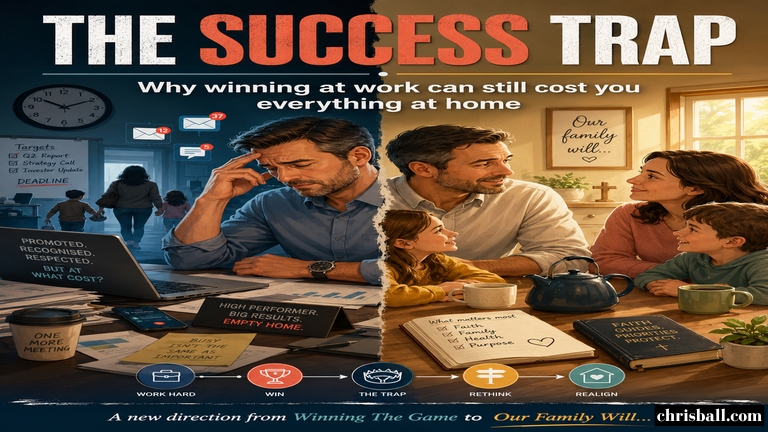
There is a strange sort of madness that can overtake a driven person. You start with good intentions. You want to provide. You want to build something. You want to prove that the idea in your head was not just a passing fancy brought on by too much coffee and an inflated sense of optimism.
So you work hard. Then harder. Then harder still, because the business starts to grow, and growth has a funny habit of bringing more work with it. Nobody warns you about that bit. Success does not arrive with a deckchair and a cold drink. It arrives with more emails, more decisions, more pressure, more bills, and more people needing you to know things you only half understand.
At first, it feels thrilling. You are building. You are winning. You are doing what all the sensible success books told you to do. Set goals. Stay focused. Push through. Keep going. Do not quit.
Good advice, up to a point.
The trouble comes when “keep going” becomes “keep going even if everything else is falling apart.”
I know this one rather well. I was running what appeared to be a successful business when my wife left me. From the outside, I probably looked like a man on the up. Busy. Driven. Capable. The sort of chap who says, “It’s all under control,” while privately wondering where he last saw his sanity.
The business was going well. The marriage was not.
That sentence took me years to understand properly.
At the time, I could have given you all sorts of explanations. I could have talked about pressure, money, stress, differences, timing, and the general unfairness of life when it refuses to behave according to the spreadsheet. Some of those things would have been partly true. Yet the deeper truth was harder to face.
My career was pulling me away from my family, and I was helping it.
Not deliberately. Very few people set out to neglect the people they love. We do not wake up one morning and think, “Today, I shall slowly damage my marriage while answering emails with great energy.” It happens more quietly than that. One late night becomes normal. One missed dinner becomes two. One distracted conversation becomes a habit. The phone appears at the table. The laptop opens after bedtime. You put your best energy into the business and bring home whatever odd bits are left in the packet.
Your family gets the crumbs.
Then one day, the people you love stop waiting for the meal.
In my case, losing my wife was only the first collapse. Over time, I also lost the desire to keep striving. Once the family had gone, the business no longer felt like a grand mission. It felt like a very expensive machine that had helped me lose the thing I should have protected. Eventually, I lost the business too. Then the home. It was a brutal education, and I do not recommend the course. The fees are ridiculous.
The odd thing about success is that it can become a poor substitute for meaning. You can win the contract, hit the target, grow the company, buy the thing, get the nod from people who admire your work, and still go home to a cold room. Or worse, to a room full of people who no longer know how to reach you.
That is why this next subject matters so much.
I have spent a lot of time writing and talking about purpose-driven success through Winning The Game. I still believe in that. Purpose matters. Goals matter. Time matters. Leadership matters. Fun, challenge, reward, and progress all matter. Yet if we talk about success without talking about family, we are leaving out the room where success is either proved or exposed.
You can be impressive in public and impossible at home. That is not success. That is performance with better lighting.
This is where my new focus begins: Our Family Will.
It comes from a much more personal place. Not from a strategy session. Not from a whiteboard. Not from one of those conferences where everyone wears lanyards and pretends the coffee is acceptable. It began with failure, faith, and a wall plaque.
By the time I met the woman who became my third wife, I knew something had to change. I had already lost too much and hurt too many people, including myself. I had no working model of what a healthy family looked like. I knew how to work. I knew how to build. I knew how to push. I did not know how to be patient, kind, forgiving, honest, gentle, or present in the way family life needs.
My wife was a Christian and took me to Christian festivals. At one of them, I saw a wall plaque that listed simple sentences beginning with the words, “Our family will…” Our family will forgive one another. Our family will be patient with each other. Our family will love and accept one another.
I read it and felt something shift. Not fireworks. Not a heavenly choir. More like someone had finally handed me the instruction sheet that should have come with marriage, parenting, and trying not to be an idiot in your own kitchen.
I bought the plaque. It is still on the wall in my kitchen.
Over time, I began to read the Bible passages behind those statements. I did not start as a theological expert. I started as a man with a battered history, a third marriage I did not want to lose, and a growing sense that God might know more about family life than I did. Hard to believe, I know, but I was willing to consider the possibility.
The more I read, the more I saw that family is not a side issue in a meaningful life. It is where the work gets real. It is where love stops being an idea and becomes patience at 7.30 in the morning. It is where forgiveness stops being a quote and becomes the decision not to bring up last Thursday again. It is where kindness becomes a cup of tea made for someone who has annoyed you. Heroic stuff. No cape required.
The Biblical approach to family is deeply practical. It asks us to forgive one another, be patient with each other, tell the truth, serve, comfort, honour, cherish, pray, and bring joy. These are not decorative ideas for embroidered cushions. They are daily choices. They are the small decisions that decide whether your house becomes a place people want to come home to or a place they recover from elsewhere.
This is probably the most serious subject in success, because your family sees the real you. Not the polished one. Not the LinkedIn one. Not the “just delighted to be here” networking breakfast version. The real one. The one who is tired, hungry, late, defensive, distracted, worried, and still capable of leaving socks in places no civilised sock should ever be found.
If your success does not make you kinder to the people closest to you, what exactly is it doing?
That is not a comfortable question, but it is a useful one.
Many people chase success because they love their family. They want to provide, protect, build, and create options. That is good. Noble, even. Yet without care, the very thing you do for your family can become the thing that removes you from them. The business gets your focus. The client gets your patience. The team gets your encouragement. Your family gets the sigh, the grunt, and the back of your head while you look at your phone.
No child has ever framed a parent’s profit-and-loss statement.
What they remember is whether you looked up when they walked in. Whether you listened. Whether you laughed. Whether you said sorry. Whether you kept showing up when it would have been easier to hide behind work.
Here is the shift I want to make, and perhaps one you may want to consider too.
Success should not pull you away from your family. It should help you serve them better.
That may mean changing the way you work. It may mean setting firmer boundaries. It may mean closing the laptop earlier. It may mean admitting that your home has become too tense, too quiet, too rushed, or too functional. It may mean praying again, even if awkwardly. It may mean starting with one sentence: “Our family will be kinder to one another this week.”
Start small. Most things that matter do.
Ask yourself tonight: what does my family receive from my success? Do they receive safety, joy, time, kindness, and attention from me? Or do they receive the leftovers after the rest of the world has taken its share?
That question is not there to shame you. I have lived this badly enough to know shame does not build much. It is there to wake you up before the bill arrives.
I am fortunate now. I rebuilt my business life. I rebuilt much of my life. I love my family, and I try to prioritise them. Not perfectly. Some days I still get it wrong. Some days the old habits tap me on the shoulder and suggest a comeback tour. But most of the time, I know what matters. God, in his patience, has spent years helping me reorder my life.
That is why I want to talk about family next.
Not as a soft subject. Not as a sentimental detour. As the heart of success.
Because if you win everywhere else and lose the people at your table, you have not won. You have simply collected prizes in the wrong room.
Put the kettle on. Look around your house. Listen to the people in it. Success may be much closer than you think. It may be standing in the kitchen, waiting for you to look up.