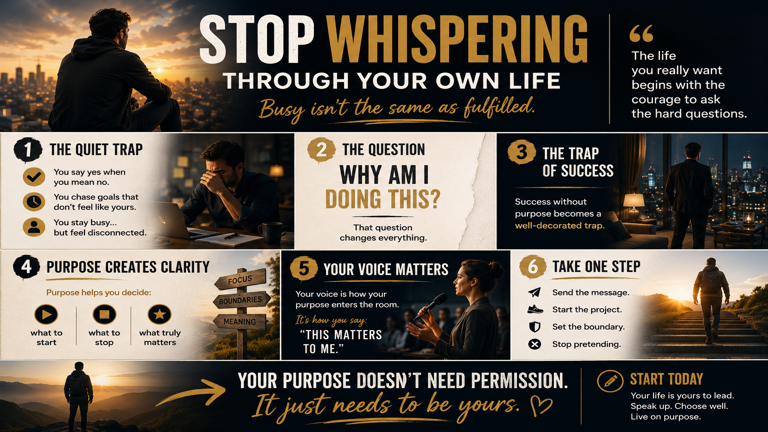
There is a strange thing that happens when life gets busy. You start making decisions on autopilot. You say ‘yes’ when you mean ‘no’. You follow plans you never really chose. You pursue goals that sound impressive but leave you feeling about as inspired as a wet sock.
At first, it seems harmless. You take the sensible job. You agree to the extra responsibility. You help with one more thing. You make choices that keep the peace, pay the bills, and avoid awkward conversations. None of that is wrong. We all have responsibilities. We all have moments when survival takes priority over self-discovery. Very few people can sit peacefully in a meadow pondering their destiny when the car insurance renewal has arrived, and the dog has just been sick on the carpet.
Yet somewhere along the way, you may notice a quiet discomfort.
You are doing plenty, but not feeling much. You are achieving things, but they do not seem to belong to you. You are busy, capable, and useful, which sounds good until you realise that useful is not the same as fulfilled.
That is often where personal purpose begins. Not with a dramatic announcement. Not with a sudden beam of light and a choir warming up in the corner. More often, it begins with a question you can no longer avoid.
Why am I doing this?
It is a simple question, but it has teeth.
I remember in my own life realising that I had spent long periods chasing success without properly asking what success was meant to give me. I wanted the business to grow. I wanted to provide for my family. I wanted to prove I could do it. Those reasons mattered. Yet when life became only about doing more, achieving more, and pushing harder, something began to drain away. Success without purpose can become a very well-decorated trap.
You can have the diary, the meetings, the targets, the invoices, the LinkedIn profile, and still feel like you are performing a part written by someone else. It is exhausting. It is also a bit embarrassing, because from the outside, everything may look fine. That is the problem with quiet discontent. It rarely has the decency to arrive wearing a flashing hat.
Finding your voice means stopping long enough to ask what matters to you. Not what looks good. Not what your parents hoped for. Not what your industry rewards. Not what social media suggests you should want while showing you someone’s suspiciously tidy kitchen.
What matters to you?
That question may sound soft, but it is one of the most practical questions you can ask. Purpose shapes choices. It helps you decide what to start, what to stop, what to keep, and what to leave alone before it eats your week and then asks for pudding.
If you know your purpose, you can make decisions with less dithering. If you do not, everything looks equally urgent. Every request feels like a duty. Every opportunity looks like it might be the one you cannot afford to miss. Before long, your life becomes a cupboard full of half-used chargers, old cables, and things you kept “just in case”. Busy, cluttered, and faintly alarming.
So let’s make this useful.
Start by looking at where your energy rises. What work, conversation, problem, or activity makes you feel more awake? What do people come to you for? What bothers you enough that you want to fix it? What kind of difference do you want to make, even in a small way?
Purpose does not have to sound grand. You do not need to save the planet before breakfast. Your purpose might be to build a stable home. It might be to help people feel heard. It might be to create work that gives others confidence. It might be to lead a team where people are treated like human beings rather than oddly shaped productivity units.
The size is not the point. Ownership is the point.
Once you begin to see your purpose, you need to give it a voice. This is where many people wobble. They have a sense of what matters, but they do not say it clearly. They hint. They hope others will notice. They drop tiny clues like emotional breadcrumbs, then feel annoyed when nobody follows the trail.
That rarely works.
Your voice is how your purpose enters the room. It is how you say, “This is what I care about.” It is how you set boundaries. It is how you explain your choices without apologising for existing. It is how you lead yourself before you try to lead anyone else.
If you want to build a life with purpose, you will need to speak more clearly. That may mean telling your team why a project matters, not just what needs to be done. It may mean telling your family that your health is no longer being treated as an optional extra. It may mean saying no to work that pays well but pulls you away from the person you are trying to become.
A small word of caution from someone who has learned this the hard way: finding your voice does not mean becoming louder, ruder, or spiritually licensed to be difficult. We all know someone who has “found their voice” and now uses it mainly to ruin dinner. That is not the aim.
Your voice should connect your values to your actions. It should bring clarity, not chaos. It should help people understand you better, not make them want to hide behind furniture.
This is where the ideas in Winning The Game come in. Life works better when you treat progress with purpose, challenge, reward, and joy. Not as a grim trudge through obligations. Not as a race to impress people who are too busy worrying about themselves to notice. A game worth playing needs a reason to play. Purpose gives you that reason.
Think of a team sport. If everyone runs hard but nobody knows the plan, the match becomes a mess. Plenty of energy, not much progress. Life can feel like that too. You can run, chase, tackle, sprint, and collapse in a heap, then realise you were never clear about the goal.
Purpose gives direction. Voice helps you share it. Action turns it into something real.
Here is a simple exercise. Take ten minutes this week and finish these sentences:
I feel most myself when I am…
I want my work to help people…
I want my family or friends to experience me as…
I am tired of pretending that…
One change I need to make is…
Do not polish the answers. Do not write what sounds noble. Write what is true. Truth is far more useful than a sentence that looks nice on a mug.
Then choose one action. Just one. Purpose becomes powerful when it leaves the notebook.
Send the message. Block the time. Start the walk. Make the call. Say the honest thing kindly. Change the routine. Begin the project. Stop volunteering for something you resent. Put the phone down when someone you love is talking to you. Radical stuff, I know. Someone alert the authorities.
The point is not to rebuild your whole life by Friday. The point is to stop whispering through it.
Your purpose does not need permission. Your voice does not need to be perfect. Your first step does not need applause. It just needs to be yours.
You may find that, once you start living with more purpose, success begins to feel different. Less like a performance. More like progress. Less like chasing. More like choosing. Less like proving your worth. More like using what you have been given.
That is the kind of success worth building. Not just bigger results, but a life that feels more honest from the inside.
So ask yourself again, without wriggling away from it.
Why am I doing this?
Then listen carefully to the answer. It may be the first time in a while that your real voice gets a turn.