There is a sentence I wish someone had said to me years ago, preferably while standing between me and my office door with the firm kindness of a nightclub bouncer.
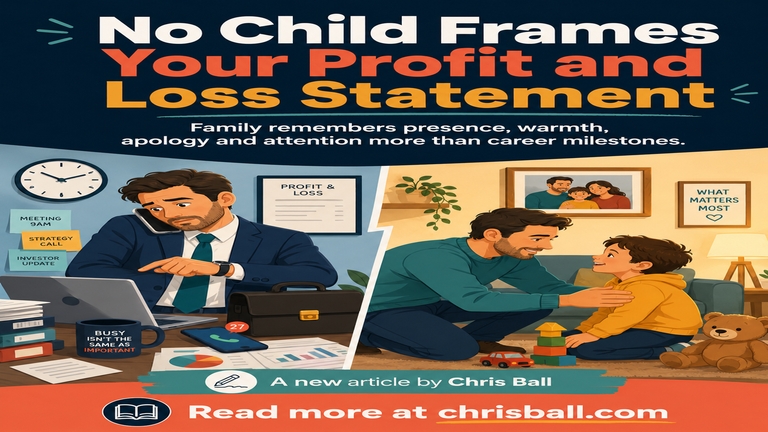
No child frames your profit and loss statement.
They do not keep your annual accounts in a memory box. They do not talk years later about the month you improved cash flow by twelve per cent. They rarely gather at Christmas and say, “Do you remember when Dad landed that client and then missed dinner for three weeks? What a treasured season.”
Children remember different things.
They remember whether you looked up when they came into the room. They remember whether you listened without checking your phone. They remember whether you laughed at their story, even when the story involved a level of detail that would test a High Court judge. They remember whether you said sorry. They remember whether the house felt warm when you were in it.
That is a tricky thought if, like many of us, you have spent years chasing the kind of success that can be measured, invoiced, praised, or put on a graph. Graphs are seductive. They sit there looking tidy and factual. Family life refuses to behave like that. No one produces a weekly dashboard showing “Dad’s emotional availability: down 14 per cent, with a worrying rise in grunting.”
Maybe someone should.
For a long time, I thought success meant building something. I still think that matters. I wrote about purpose-driven success in Winning The Game because I believe deeply in purpose, goals, time, leadership, resilience, and joy. Those things matter. Life works better when you know what game you are playing, why it matters, and how to get back up when it knocks you sideways.
Yet there is a danger hidden inside ambition. It can convince you that the visible score is the only score.
The business grows, so you assume life is improving. The diary fills, so you assume you are useful. People ask for your advice, so you assume you are becoming wise. The bank balance improves, so you assume your family must be better off.
Maybe they are.
Maybe they are not.
The awkward question is this: what is your success doing to the people who live with you?
When I was running a successful business, I thought I was doing many of the right things. I worked hard. I carried responsibility. I tried to provide. I pushed through problems. I kept going. From the outside, it looked like progress.
At home, something else was happening.
My career was taking more of me, and I was letting it. The business got the sharpest version of me. My family got the tired version. The business got my focus. My family got my distraction. The business got my problem-solving brain. My family got the low-battery warning.
Then my wife left me.
That moment did not simply break my heart. It broke the story I had been telling myself. I had thought I was building success for my family. Slowly, painfully, I began to see that I had also been building distance from them.
That is a hard thing to admit. I would much rather tell you I was noble, misunderstood, and tragically overworked, preferably while staring out of a rain-streaked window. The truth is less cinematic. I had lost sight of what mattered most.
Once my family broke apart, the business began to lose its meaning. I lost the desire to strive. Then I lost the business. Then the home. It turns out that achievement can feel rather hollow when the people you wanted to share it with are no longer there.
That is why this next theme matters so much to me.
Our Family Will is not a neat change of subject from success. It is the deeper question beneath it.
What if real success includes the way your family experiences you?
Not the public version of you. Not the cheerful one at meetings. Not the polished one who can write a thoughtful email while quietly wondering whether lunch can count as breakfast. The real one. The one at home. The one who walks through the door after a long day and decides, in that small moment, what the family will receive.
Will they receive warmth?
Will they receive attention?
Will they receive patience?
Will they receive an apology when you get it wrong?
Will they receive joy?
Or will they receive the leftovers?
That is where the ideas from Winning The Game and Our Family Will meet. Rise Up Self asks us to find purpose and become the kind of person who lives from it. Eating the Elephant reminds us that life changes through manageable steps, not dramatic bursts of heroic intent followed by a nap. Honour Each Other asks us to see the value in the people around us. Cherish One Another asks us to treat them as precious, not merely familiar.
Those ideas belong together.
If you rise up, but do not become kinder at home, what have you risen into?
If you manage your time, but never make time for your child, what have you managed?
If you achieve your goals, but your spouse feels invisible, what did the goal cost?
If your family does not feel cherished by you, who exactly is meant to be impressed by your success?
The word cherish can sound soft, but it is not. Cherishing someone means treating them as someone you could lose. That changes the tone of a room. It changes how you speak. It changes whether you look up. It changes whether you say, “Give me five minutes,” or “Come here, tell me now.”
Honour works the same way. Honour is not grand. It often looks like attention. You honour your spouse by listening to the whole sentence. You honour your child by taking their small worries seriously. You honour your ageing parent by ringing when it is not convenient. You honour your family by refusing to treat them as background noise.
That is practical. Painfully practical. No scented candle required, though if one helps, light the thing.
So what can you do this week?
Start with one ordinary moment.
When someone you love walks into the room, look up. Not half up. Not the pretend look-up while your thumb continues scrolling. Properly look up. Let your face say, “I am glad you are here.”
Ask a better question. Not “How was your day?” which often receives the internationally accepted answer, “Fine.” Try, “What was the best bit of your day?” or “What felt hard today?” Then listen. Do not fix too soon. Most people do not need a management consultant at the dinner table.
Say sorry faster. A slow apology gathers excuses. A fast one repairs the room.
Put one family moment in your diary and protect it like a client meeting. If a customer deserves your punctuality, your child deserves at least the same courtesy. Possibly more, since the child is less likely to send a purchase order.
And choose one sentence for the week: Our family will cherish one another.
Then practise it. Not as a slogan. As behaviour.
Cherish them when they interrupt you.
Cherish them when they are slow.
Cherish them when they tell the same story again.
Cherish them when they leave shoes in the hallway as if staging a footwear protest.
This does not mean becoming sentimental. Families do not need more theatre. They need small proof. They need presence, warmth, apology, and attention.
A profit and loss statement may tell you whether the business is working. It will not tell you whether your home is. For that, you need to look at faces. Listen to tone. Notice whether people relax when you enter the room or brace themselves.
That is the real report.
I still believe in success. I still believe in purpose, goals, growth, and doing meaningful work. I just no longer want a version of success that asks my family to pay the bill.
So ask yourself today: what will the people closest to me remember?
Not what I achieved.
Not what I earned.
Not what I owned.
What will they remember about how it felt to be loved by me?
That question may not fit on a spreadsheet. It may be the most useful measure you ever use.