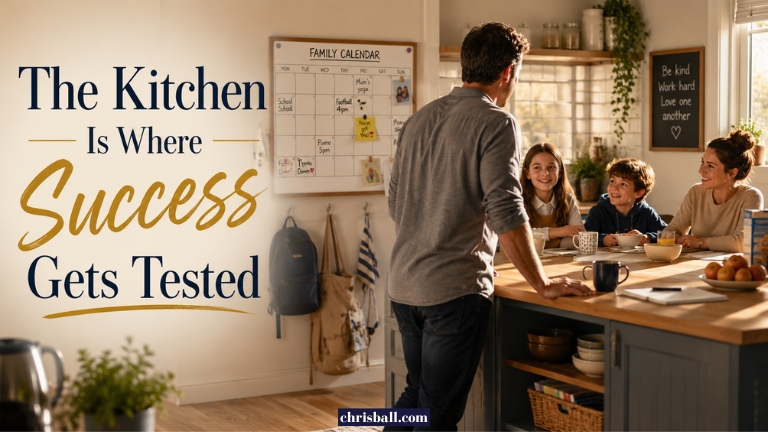
You can learn a lot about a person in a kitchen.
Not the showroom kitchen. Not the one with the spotless island, the tasteful fruit bowl, and a coffee machine that looks as if it might need its own insurance policy. I mean the real kitchen. The one with toast crumbs, school letters, half a packet of biscuits, a mug no one claims, and a family calendar that looks as if it were planned by someone with a grudge.
That is where success gets tested.
Not in the meeting room. Not on a stage. Not when you are wearing the good jacket and speaking in the voice you reserve for clients, bank managers, and people who might give you money. Success gets tested when you walk into your home tired, hungry, distracted, and slightly irritated because the day has behaved badly.
What happens next tells the truth.
Do you bring warmth into the room?
Do you bring tension?
Do you look up?
Do you listen?
Do people relax when you arrive, or do they quietly prepare themselves?
That last question is not one to skim past. It has sharp edges.
For years, I thought leadership belonged mostly to work. You lead the team. You make decisions. You set direction. You deal with problems. You hold the line. You try to keep everyone moving in roughly the same direction, which on some days feels like herding cats with a PowerPoint presentation.
In Winning The Game, I wrote about leadership through the idea of Being the Captain. It still matters. Someone needs to take responsibility. Someone needs to communicate clearly. Someone needs to stay steady when things go wrong. Someone needs to decide what sort of game is being played and how the team should play it.
Yet the hardest team to lead is not always the one at work.
It is the one at home.
At work, people may listen because of your role. At home, nobody cares about your title. Your children are not impressed by your job description. Your spouse does not become easier to love because your annual review went well. Your family measures leadership in smaller units.
Did you tell the truth?
Did you keep your word?
Did you apologise?
Did you help?
Did you notice?
Did you bring peace, or did you bring the office home in your face?
This is where public success can become awkward. You may be respected outside the house and resented inside it. You may be calm with clients and sharp with your family. You may give encouragement at work and criticism at home. You may talk about values in meetings while leaving your nearest people to guess whether they still matter.
That is not leadership. That is branding.
The kitchen does not care about branding.
The kitchen is where integrity turns up wearing slippers. It is where the polished version of you has gone upstairs, changed clothes, and left the real version standing by the sink wondering why nobody emptied the dishwasher. Again.
This is where Our Family Will… begins to matter.
One of the most striking ideas in that book is that family life is not built in grand moments. It is built tomorrow morning, in your kitchen. It is built when someone is late, when the cereal has run out, when the teenager gives a one-word answer, when your spouse says something ordinary but your tired brain hears it as an accusation.
It is built when you choose what kind of person you will be in the next thirty seconds.
That sounds small. It is not.
Most families do not fall apart because of one dramatic row involving thunder, violins, and a smashed vase. They cool by degrees. A sharp word here. A silence there. Another evening on the phone. Another apology delayed. Another small kindness withheld because, frankly, you were tired and felt you had done enough for humanity that day.
I understand this too well. I have known what it is to give too much of myself to work and too little to home. I have known what it is to think I was being responsible, while my priorities quietly drifted out of order. I have known what it is to realise, too late, that the business was not the only thing needing leadership.
A family needs leadership too. Not bossiness. Not control. Not one person marching round the house like a domestic field marshal demanding socks, order, and immediate gratitude. Real family leadership looks different.
It looks like going first in kindness.
Going first in apology.
Going first in listening.
Going first in prayer.
Going first in turning the temperature down when the room begins to heat up.
This is not glamorous. No one gives you a trophy for not snapping at 7.42 in the morning. Though perhaps they should. A small bronze kettle, maybe. I would display mine proudly.
But this is the work.
If being the Captain means anything, it must mean taking responsibility for the atmosphere you create. Not the whole atmosphere, of course. You are not responsible for every mood, sulk, sigh, or door closure in your house. Family members arrive with their own weather systems. Some teenagers can produce fog without training.
But you are responsible for what you bring.
Do you bring your best effort only to work?
Do you spend your patience before you get home?
Do you use your family as the place where all the strain leaks out?
Do you expect them to understand pressure you have never explained?
These questions matter because the people closest to you experience your success before they admire it.
If your success makes you more absent, more irritable, more distracted, and more convinced that everyone should be grateful for the sacrifices you are making, your family may not experience it as success. They may experience it as a rival.
That is a painful thought.
The good news is that change can start in the same place the damage often appears: the kitchen.
Tomorrow morning, try something simple. Before you check your phone, check the room. Who is there? What do they need from you? A smile? A kind word? A lift? Help with a bag? A calmer tone? A joke so bad it causes mild distress?
Ask yourself one question before the day begins.
How can I make this home easier to live in today?
Not perfect. Easier.
That one question can change the direction of a family. It moves you from passive resident to active builder. It reminds you that success is not only something you achieve elsewhere. It is something you practise here, with these people, in this house, before the kettle has boiled.
This is where integrity becomes practical. If I say family matters, my diary should show it. If I say love matters, my tone should show it. If I say faith matters, my behaviour in the kitchen should show it. If I say I want to serve, the dishwasher is sitting there with a smug expression, ready to test my theology.
Our Family Will… gives language to this kind of life.
Our family will forgive one another.
That means I do not keep a private archive of every offence.
Our family will be patient with each other.
That means I do not treat delay as a personal attack.
Our family will tell the truth.
That means I stop saying “fine” when my face is clearly filing a complaint.
Our family will serve one another.
That means love sometimes looks like doing the boring job without a speech.
Our family will cherish one another.
That means I treat the people in my home as gifts, not interruptions.
This is not a sentimental view of family. It is a demanding one. It asks for action when you are tired. It asks for humility when you would rather be right. It asks for presence when your phone is waving at you like a needy toddler.
But it also offers something better than public achievement alone. It offers a home where success has somewhere to land. A place where the people who know you best can still feel glad when you walk through the door.
That is no small thing.
So, yes, keep building. Set goals. Lead well. Manage time. Pursue purpose. Play to win.
But remember where the final test happens.
It happens when the laptop closes.
It happens when the front door opens.
It happens when you step into the kitchen, and the people you love look up.
What will they receive from you today?
That may be the real measure of success.