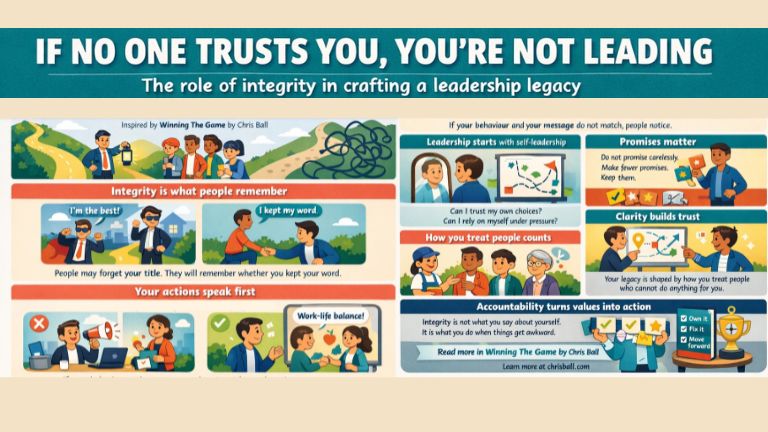
A great many people like the sound of leadership far more than the substance of it. They enjoy the title, the LinkedIn update, the slightly more upright posture in meetings, and the chance to say things like “Let’s circle back” without being arrested. What they do not always enjoy is the awkward truth at the centre of it all: leadership is built on integrity, and integrity is dreadfully inconvenient.
It is inconvenient because it asks you to be the same person in private as you are in public. It asks you to keep your word when nobody is clapping. It asks you to tell the truth when a small lie would make life easier and your inbox quieter. It asks you to act in a way that people can trust, even when being trusted costs you something.
That is not glamorous. It will not get you a heroic soundtrack. Yet it is the thing people remember.
When people talk about leaders who left a mark on their lives, they rarely start with charisma. They do not say, “She had a marvellous way with quarterly targets.” They say, “He was fair.” “She kept her word.” “He did what he said he would do.” “She treated people properly.” That is integrity. It is not shiny, but it lasts.
In Winning The Game, leadership is not presented as some mystical gift handed out at birth to a lucky few. It is treated as something built, choice by choice, habit by habit, conversation by conversation. That matters because it means your leadership legacy is not waiting somewhere in the future like a prize on a shelf. You are already building it now, whether you mean to or not.
Every time you duck responsibility, you build it.
Every time you take responsibility, you build it.
Every time you promise one thing and deliver another, you build it.
That should sober you up faster than a tax bill.
Sir Clive Woodward understood this well. When he led England to Rugby World Cup victory in 2003, he did not do it by shouting louder than everyone else or pretending to be the smartest man in every room. He built standards. He created clarity. He developed trust. He expected people to take responsibility for their role and their conduct. He knew that talent without character is a bit like owning a sports car and forgetting the steering wheel. Lovely to look at, not much use on a sharp corner.
The best leaders do not simply chase results. They build a culture in which results become more likely because people trust the person at the top. Trust is not created by posters on office walls or by declaring that “people are our greatest asset” before cutting the biscuit budget. Trust is built when people see that your behaviour matches your message.
If you tell your team that wellbeing matters, but wear exhaustion like a medal and send emails at 11.47pm with “quick one before bed”, they notice.
If you tell your children that honesty matters, but ask them to say you are “not in” when someone rings the doorbell, they notice.
If you tell yourself that your values matter, but abandon them the moment life gets awkward, you notice.
That last one matters most. Leadership begins with self-leadership. Before you can guide other people, you have to be able to guide yourself. Can you trust your own decisions? Can you rely on yourself to do the right thing when nobody would blame you for doing the easy thing? Can you keep your standards when life gets busy, annoying, or expensive?
That is where integrity stops being a noble idea and becomes a daily practice.
This is not about sainthood. If it were, most of us would be out by Tuesday lunchtime. It is about consistency. It is about closing the gap between who you say you are and how you actually behave. That gap is where credibility goes to die.
I have seen this play out in business many times. A leader can be brilliant on strategy, quick with numbers, and dazzling in a presentation, yet still weaken the whole team by being unreliable. One broken promise does more damage than ten polished speeches can repair. People may nod in the meeting, but inwardly they have already adjusted their expectations. They stop believing the words. They begin protecting themselves. They do the minimum. The rot starts there.
By contrast, a leader with integrity creates something solid. Not perfect. Solid. People know where they stand. They know the rules are real. They know praise is genuine and criticism is fair. They know that bad news can be spoken aloud without the room turning into a courtroom drama. That kind of leadership frees people. It helps them work better because they waste less energy second-guessing motives and guarding their backs.
So how do you build that kind of integrity in practice?
Start with your promises. Do not make them lightly. The modern world encourages endless agreement. We say yes too quickly, over-commit, then act surprised when reality arrives and sits on our chest. A person of integrity treats promises with respect. If you say you will do something, do it. If you cannot, say so early. Not after the deadline has sailed off into the sunset, waving rudely.
Next, be clear. Integrity is not only moral. It is practical. Vague leaders create confusion, then blame other people for being confused. If you want trust, speak plainly. Say what matters. Say what success looks like. Say what needs to happen next. Clear communication is one of the kindest things a leader can offer.
Then look at how you treat people who cannot do anything for you. That is a revealing test. Are you respectful only when it is useful? Or do you carry yourself with decency across the board? Your legacy will not be shaped only by how you dealt with the board, the clients, or the star performer. It will be shaped by how you treated the quiet person, the struggling colleague, the family member who annoyed you, the person who made a mistake on a bad day.
And then there is accountability, which nobody enjoys, and everybody needs. Integrity without accountability is just self-description. You cannot simply declare yourself principled and hope the matter is closed. You need to review your behaviour honestly. Where are you drifting? Where are you making excuses? Where are you asking more of others than you ask of yourself?
Those questions are not comfortable. They are useful.
A leadership legacy is not crafted in one giant moment. It is formed in the ordinary days. In the meeting where you give credit away instead of keeping it. In the conversation where you admit you got it wrong. In the decision to stay fair when favouritism would be easier. In the discipline of turning up as the same person again and again.
What kind of leader are you becoming while you chase success? That is the bigger question. Plenty of people achieve impressive things and leave a trail of scorched relationships behind them. That is not a legacy. That is just damage with a biography attached.
The stronger path is slower and less noisy. It asks you to build something you can live with. A reputation that stands up when examined. A way of leading that your team, your family, and your future self can respect.
If that sounds demanding, it is. If it sounds worth doing, it’s that too.
Winning The Game makes the case that success is not just about goals, growth, and results. It is also about the kind of person you become while pursuing them. Leadership without integrity may get applause for a while. Leadership with integrity leaves something better behind.
And in the end, that is the winning that actually counts.