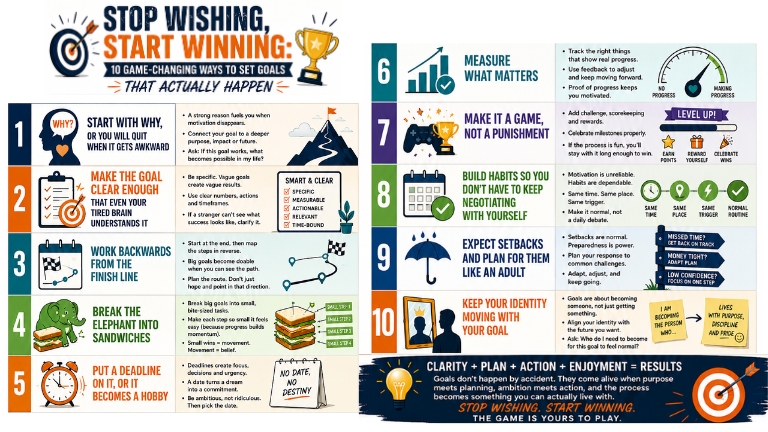
Most people are not short of goals. They are short of follow-through.
They want to get fit, write the book, grow the business, fix the finances, sort the house, learn Spanish, and become the kind of person who drinks water with lemon and somehow enjoys it. The problem is rarely ambition. The problem is what happens on a damp Tuesday when motivation has wandered off and your grand plan is staring at you like an unpaid parking fine.
This is where goal-setting usually falls apart. Not because people are lazy. Not because they do not care. It falls apart because their goals are vague, badly timed, joyless, or built on wishful thinking. They have a dream, but no route. A destination, but no map. A vision board, but no calendar. Or, the next step is dull and tedious.
Winning The Game tackles this head-on. It treats success not as some mystical event that lands on your doorstep wearing a tuxedo, but as something built with purpose, structure, discipline, and a healthy dose of fun. That last part matters more than many people admit. If your goals feel like a punishment, you will avoid them like a neighbour selling raffle tickets.
So here are 10 ways to set goals that do more than sound good in your head.
1. Start with why, or you will quit when it gets awkward
A goal without a reason behind it is fragile. It snaps the moment life gets busy.
You cannot just say, “I want to lose weight” or “I want to grow my business.” Why? What changes if you do? What pain does it solve? What future does it create? If your answer is weak, your effort will be weak too.
A friend of mine told me about when he was running a marathon and, about halfway through, he wanted to quit. He also could not remember why he started in the first place. If that had been all he did, then he would have stopped at that point. But he had his why written on the back of his hand, so that when the going got tough, he could keep his motivation and momentum going.
When your reason is strong, your goal becomes personal. You are not just trying to make more money. You are trying to reduce pressure at home. You are not just training for a race. You are proving to yourself that your best days are not behind you.
Ask yourself this: if this goal works, what becomes possible in your life?
That is where commitment starts.
2. Make the goal clear enough that even your tired brain understands it
A surprising number of goals fail because they are woolly. “Do better” is not a goal. “Get organised” is not a goal. Those are polite little phrases people use when they want to feel ambitious without being pinned down by detail.
A useful goal is clear. “Increase revenue by 15 per cent in six months.” “Walk 10,000 steps five days a week.” “Finish the first draft by 30 September.”
Specific goals remove the wriggle room. They also remove the excuse of confusion. Your brain likes clarity. It does not like fog.
If a stranger looked at your goal, would they know exactly what success looks like? If not, sharpen it.
3. Work backwards from the finish line
This is one of the most practical ideas in Winning The Game, and it works because it stops you from sitting at the start staring at the size of the thing.
Begin with the end result. Then ask, what has to happen right before that? And before that? And before that?
If you want to launch a course, do not start by panicking about the whole thing. Start at launch day, then reverse-engineer the steps. Sales page done. Emails written. Content recorded. Structure decided. Topic chosen.
Suddenly the mountain becomes a list.
Amy Johnson did not fly to Australia by hoping very hard and pointing the plane south-east. She planned the route. She thought ahead. She dealt with the real world as it was, not as she wished it to be. That is how bold goals get done.
4. Break the elephant into sandwiches
A large goal is often just a collection of small tasks wearing a false moustache.
People get overwhelmed because they try to swallow the whole thing in one go. That is how you end up “researching” for three hours while eating toast and calling it progress.
Break it down. Then break it down again. If a step still feels heavy, it is too big.
Not “write the chapter.”
Try “draft 300 words on the opening story.”
Not “sort my finances.”
Try “download last three bank statements.”
Small wins matter because they create movement. Movement matters because it creates belief. And belief is often what people lose first.
5. Put a deadline on it, or it becomes a hobby
Goals without deadlines drift. They become those noble intentions you mention every January and quietly ignore by March.
A deadline creates focus. It also forces decisions. If something must happen by a certain date, you stop treating it like a vague dream and start treating it like an appointment with consequences.
The moon landing did not happen because someone said, “We should pop up there one day.” It happened because there was a clear target and a fixed point in time. Deadlines create urgency. Urgency creates action.
Be sensible, of course. Do not give yourself 48 hours to become financially free and spiritually balanced. But do pick a date.
6. Measure what matters
If you do not track progress, your goal can start to feel like one long, joyless trudge through beige wallpaper.
Measurement gives feedback. It tells you whether your effort is working. It also gives you proof that you are moving, which helps on the days when your brain insists you are achieving nothing and should probably take up lying down as a lifestyle.
Track the right things. If your goal is writing, track words written or time spent. If your goal is fitness, track sessions completed or strength improved. If your goal is business, track leads, conversions, or revenue.
Do not track nonsense just because it is easy to count. Busyness is not progress.
7. Make it a game, not a punishment
This is where many adults make life unnecessarily grim. They treat goals like detention. All seriousness, no reward, no fun, no texture. Then they wonder why they keep drifting back to biscuits and avoidance.
Gamification works because your brain enjoys challenge, progress, scorekeeping, and reward. Children know this. Athletes know this. Anyone who has ever become wildly competitive over a family board game knows this.
So use it. Create levels. Reward milestones. Compete with yourself. Use charts, points, treats, mini-targets, or weekly wins. Celebrate progress properly. Not with a vague nod and a cup of tea. With something that feels earned.
If the process is miserable, you will not stay with it long enough to win.
8. Build habits so you do not have to keep negotiating with yourself
Motivation is lovely when it turns up. Shame it is so unreliable.
Habits are what carry you when enthusiasm has gone missing. If you rely on feeling inspired every day, you are building your future on a weather forecast.
Make the goal part of your routine. Same time. Same place. Same trigger. Reduce the number of decisions needed.
A writer who waits for the muse often writes very little. A writer who sits down every morning at 8.00 has a better chance. The same goes for training, planning, selling, saving, or studying.
You do not need to feel ready. You need to make it normal.
9. Expect setbacks and plan for them like an adult
A great many people treat setbacks as proof that the goal was flawed, they are flawed, the world is unfair, and possibly Mercury is in retrograde. It is exhausting.
Setbacks are part of the process. Not a pleasant part, but a normal one. The trick is not to act shocked when life interrupts your perfect plan.
What will you do if you miss a week? What if money gets tight? What if the launch flops? What if you lose confidence halfway through?
Think about these things before they happen. A plan for the wobble often stops the wobble from becoming a collapse.
Yelena Isinbayeva, the Olympic gold medal-winning pole vaulter, did not become great by insisting life stick to her original script. She adapted. So can you.
10. Keep your identity moving with your goal
This part gets missed too often. Goals are not only about getting something. They are about becoming someone.
You are not just trying to run a business. You are becoming a person who leads well. You are not just trying to get fit. You are becoming someone who respects their health. You are not just saving money. You are becoming someone who handles life with more intention.
That matters because identity drives behaviour. If you still see yourself as disorganised, inconsistent, or someone who “never finishes things,” your habits will keep obeying that script.
Start asking, who do I need to become for this goal to feel normal?
That question changes everything.
Goals do not come alive because you wrote them in a notebook and bought new pens. They come alive when purpose meets planning, when ambition meets action, and when the process becomes something you can actually live with.
That is one of the strongest themes running through Winning The Game. Success is not about driving yourself into the ground while pretending you are enjoying the hustle. It is about building a life and a way of working that is purposeful, structured, and alive enough to keep going.
So what is your goal right now? Is it clear? Is it real? Is it broken down enough to start? Is it enjoyable enough to sustain?
Because the difference between people who stay stuck and people who move forward is often not talent. It is that one group stops at wanting, and the other gets serious about how winning actually works.