There is a question I wish I had asked myself when I was chasing business success with the energy of a man trying to outrun a swarm of angry wasps.
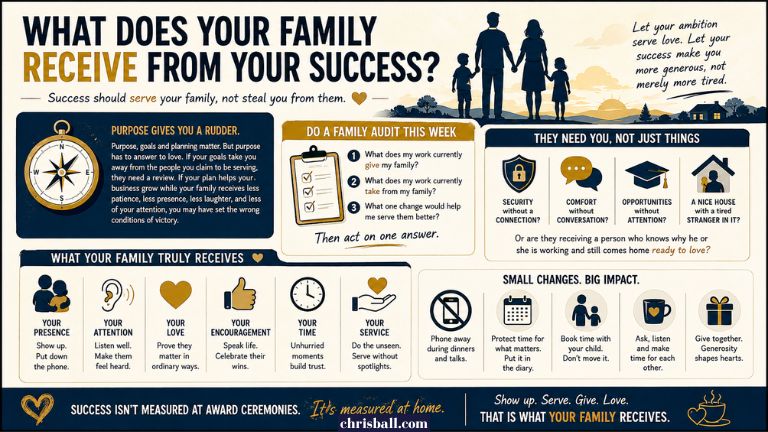
What does my family receive from all this?
Not what they own because of it.
Not what does it pay for?
Not what lifestyle does it make possible?
What do they actually receive from me?
That question is more awkward than it first appears. Most of us like to think our ambition serves our family. We work hard because we want to provide. We take the call because the client matters. We stay late because the project needs finishing. We miss dinner because there is a deadline. We tell ourselves it is all for them.
Sometimes it is.
Sometimes it slowly becomes for the work itself, for the win, for the praise, for the status, for the private satisfaction of being needed by everyone except the people who know where you keep your socks.
That is when success starts behaving badly.
Purpose-driven success, the kind I explored in Winning The Game, begins with a clear reason. Why are you doing this? What is the goal? What is the game you are playing? What does winning look like? In Setting the Sails, the focus is on choosing direction, setting goals, and creating a plan that can survive real life, which has never shown much respect for tidy plans.
That still matters. A life without direction can become a long series of reactions, errands, bills, meetings, and unexplained noises from the car. Purpose gives you a rudder. Goals help you move. Planning stops you from drifting into a decade you did not choose.
Yet purpose has to answer to love.
If your goals take you away from the people you claim to be serving, they need a review. If your plan helps your business grow while your family receives less patience, less presence, less laughter, and less of your attention, you may have set the wrong conditions of victory.
There. I said it. Annoying, but possibly useful.
When my first marriage broke down, I had to face the painful possibility that I had mistaken provision for presence. I was working hard. I was building. I was taking responsibility. Those things were not wrong. The problem was that I had allowed them to become the whole story. My career had begun to steer my life, and I had become oddly proud of how busy I was.
Busy can become a badge. It can also become a hiding place.
I lost my wife. Later, I lost the desire to keep striving. Then I lost the business. Then the home. I do not share that as a neat moral lesson tied with a ribbon. It was not neat. It was painful, slow, and expensive in every possible sense. It forced me to ask whether success that does not strengthen your family can really be called success at all.
That question now sits at the heart of the transition from Winning The Game to Our Family Will….
Success should serve your family, not steal you from them.
The language of Our Family Will… takes this out of the world of theory and brings it into the kitchen, which is where most honest theology eventually ends up. Our family will serve one another. Our family will be generous to one another. These statements sound simple enough until you try to practise them while tired, hungry, slightly irritated, and standing beside a dishwasher that has apparently entered a rebellious phase.
Serving one another sounds noble in a book. In real life, it often looks like doing the thing nobody wants to do.
Washing up.
Listening properly.
Giving someone the larger slice.
Letting another person rest.
Making tea without holding a press conference about your sacrifice.
Helping with homework while your inner self quietly leaves the room.
This is where success gets tested. Not in the award ceremony. Not in the bank account. Not in the admiration of people who see you for half an hour with your best shirt on. At home, your success shows itself in what you give.
A family does not thrive on money alone. Money helps, of course. Let us not pretend the electricity bill can be paid with “quality time” and a warm smile. Providing matters. Work matters. Financial responsibility matters. But if money arrives wrapped in absence, irritation, and silence, the family may pay more than it receives.
So ask yourself: what is your family receiving?
Are they receiving security without a connection?
Comfort without conversation?
Opportunities without attention?
A nice house with a tired stranger in it?
Or are they receiving a person who knows why he or she is working and still comes home ready to love?
The difference matters.
Serving your family does not mean abandoning ambition. I have no interest in telling people to stop building, stop striving, or stop pursuing meaningful work. That would be nonsense. We need people who create, lead, build, teach, heal, organise, solve, invent, repair, and generally keep civilisation from collapsing into a queue of people arguing about parking.
The point is not to reduce ambition. The point is to redeem it.
Let your ambition serve love. Let your goals answer to your values. Let your success make you more generous, not merely more tired. Let your planning include school plays, anniversaries, unhurried meals, phone-free evenings, and time to listen when someone says, “Can I talk to you?”
If it is not in the diary, it often does not happen. That is one of the more irritating truths of adult life. In business, we schedule what matters. Meetings. Calls. Reviews. Deadlines. Follow-ups. Strategy sessions. Even the deeply mysterious “catch-up”, which can mean anything from a useful conversation to forty-five minutes of professional fog.
Yet at home, we often leave the most important things to chance.
We assume we will find time to talk.
We assume our children know we care.
We assume our spouse understands the pressure.
We assume love can survive on intention alone.
It cannot. Love needs action. Repeated action. Small action. Often dull action. That is why serving and generosity belong at the centre of family life.
Generosity is not only about money. It is about spirit. Are you generous with your attention? Your encouragement? Your apology? Your patience? Your praise? Your time? Or do you ration those things at home because work has already spent them?
A generous home feels different. People do not have to compete for every scrap of warmth. They do not need to perform for attention. They know they matter because someone keeps proving it in ordinary ways.
Here is a practical exercise. This week, do a family audit. Not the terrifying kind involving spreadsheets and a sense of doom. A human one.
Ask three questions.
What does my work currently give my family?
What does my work currently take from my family?
What one change would help me serve them better?
Then act on one answer.
Leave on time once.
Put your phone in another room during dinner.
Book time with your child and do not move it.
Ask your spouse what has felt heavy recently.
Do one unseen job without expecting applause, which is deeply unfair but spiritually good for you.
Give something away as a family, so generosity becomes shared and not just a line in a budget.
Small changes count. In Winning The Game, the idea of eating the elephant matters because big outcomes come from manageable actions. Family life works the same way. You do not rebuild trust through one heroic Saturday. You rebuild it through repeated proof.
You show up.
You listen.
You serve.
You give.
You apologise.
You try again.
Then, slowly, your family begins to receive something better from your success. Not only money. Not only opportunity. They receive a more present you.
That may be the best thing your success can give them.
I still believe in ambition. I still believe in purpose. I still believe in setting the sails and moving towards something meaningful. I just believe the sails need checking. Every so often, you must ask where the wind is taking you and who is getting left behind on the shore, waving politely while wondering whether you plan to come back.
So ask the question today.
What does my family receive from my success?
If the answer troubles you, good. That may be the beginning of something better.
Not guilt. Not panic. Not a dramatic announcement over dinner that everyone finds unsettling.
Just a different choice.
A phone was put down.
A cup of tea was made.
A child listened to.
A spouse thanked.
A job finished early enough for home to receive more than the leftovers.
That is where success begins to change shape.
And perhaps that is where your family begins to receive what they needed from you all along.