There are few things more depressing than a workplace where nobody cares.
The lights are on. The coffee is dreadful. The printer is making a noise that suggests it has lost the will to live. People turn up, do the bare minimum, and leave with all the joy of passengers exiting a delayed coach in Swindon. Work gets done, in the technical sense, but nobody would confuse the atmosphere with momentum.
Then somebody comes along with a chalkboard.
Not a leadership manual. Not a six-hour strategy day with dry pastries and the phrase “moving forward” used as if it were a sacred chant. Just a chalkboard. A simple score, a bit of competition, a reason to pay attention.
That is the sort of story I love because it proves something Winning The Game keeps coming back to. People do not come alive because you tell them to work harder. They come alive when you give them a reason to care, a way to play, and a chance to win.
One of the simplest examples in the book is Mike, a warehouse team leader on the night shift. He was not a celebrity CEO. He was not standing on a stage in a black polo neck telling the world to think differently. He was managing a team that most people overlooked, doing work most people barely noticed, during hours when most people were at home in pyjamas pretending they would only watch one episode.
The day shift had better numbers. Better visibility too. They were seen more often, praised more often, and no doubt felt faintly superior in the way some people do simply because they work when the sun is up. Mike’s team had the awkward slot. Less glamour. Less attention. Same need to perform.
He could have accepted that. Plenty do. They shrug, blame the circumstances, and carry on plodding. Instead, he created a game.
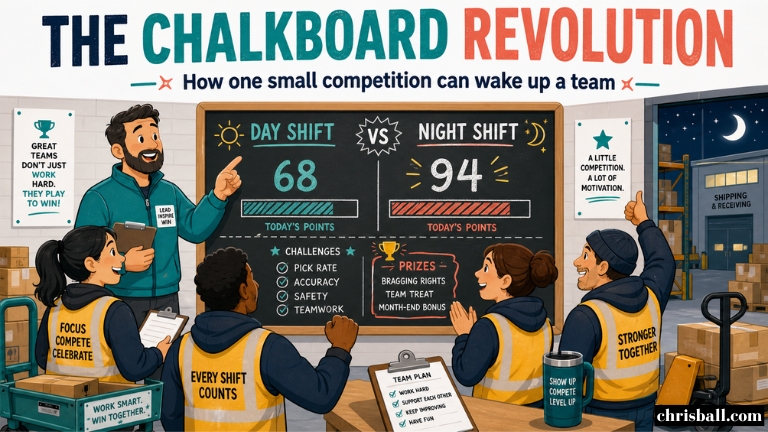
He put up a chalkboard with the scores from the day shift and the night shift. He turned output into a visible contest. He added a trophy. Nothing grand. Just enough to make it matter. Then he sweetened the deal with a prize. If the night shift won for the month, they would get a night out together.
That was it. No giant budget. No software platform. No consultant charging five figures to rediscover human nature. Just a scoreboard, a challenge, and a reward.
The result was immediate. The team paid attention. They talked more. They pushed each other. They cared. Productivity went up because the work had changed shape. It was no longer just a list of tasks. It had become a contest. It had a story. It had social life. It had pride attached to it. People were no longer dragging themselves through the shift. They were trying to beat the other lot.
This matters because most leaders still make the same mistake. They assume money is the only motivator worth mentioning. Money matters, of course. Nobody wants to be paid in “valuable experience” and a weak handshake. Yet money on its own rarely creates energy. It does not create team spirit. It does not make people grin at 2am while hauling boxes about.
What does? Progress. Recognition. Purpose. Belonging. The chance to feel that your effort counts for something.
That is what Mike understood.
He also understood something else that many leaders miss because they are too busy sounding serious. Fun is not the enemy of performance. Boredom is. When work becomes flat, people disengage. They stop thinking. They stop caring. They go into survival mode, which is fine if you are escaping a flood but not ideal if you are running a business.
Gamification, when done properly, is not childish. It is practical. It takes what human beings already respond to and uses it on purpose. We like goals. We like progress. We like feedback. We like winning. Even people who insist they are “not competitive” can become oddly intense when there is a score involved. Put a board up, add a trophy, and suddenly Barbara from accounts is behaving like she has entered the Olympic finals.
That is not silly. That is useful.
The best part of this story is that the chalkboard did more than raise output. It changed Mike’s role. He stopped being just the person checking targets and started becoming a leader. There is a difference. Managers watch activity. Leaders create meaning around it. Managers tell people what to do. Leaders help people want to do it. Managers count boxes. Leaders build belief.
That belief does not need to come wrapped in dramatic language. In fact, it usually works better when it does not. Mike was not delivering soaring speeches about the dignity of labour under fluorescent lighting. He was simply saying, in effect, “We can beat them. Let’s have a go.”
And there is something rather brilliant about that.
You can use this in your own life and work far more easily than you may think. You do not need a warehouse. You do not need a night shift. You do not even need a trophy, though a trophy never hurts.
If you lead a team, what could you turn into a game? Could you track wins more visibly? Could you celebrate progress more often? Could you create mini-challenges between departments, weeks, or projects? Could you build in rewards that people actually care about rather than a stale muffin and an email saying “well done everyone”?
If you work alone, the same principle still applies. One of the strongest themes in Winning The Game is that success becomes more likely when the process has energy in it. That means you can score your own progress. Set levels. Reward milestones. Give yourself targets that are clear enough to chase and satisfying enough to hit.
Why should children have all the fun? Adults need this more, not less. Children already know how to play. Adults need reminding because they have spent too many years acting as if exhaustion is a personality trait.
This is where leadership and gamification meet in a useful way. Leadership is not just about giving direction. It is about shaping the environment in which people work. If the environment is dead, do not be surprised when the people in it start behaving as if someone has unplugged them. If the environment has challenge, humour, clarity, and visible progress, people tend to wake up.
That is not manipulation. It is design.
The chalkboard worked because it gave people three things they were missing. First, it gave them visibility. They could see how they were doing. Second, it gave them identity. They were not just workers on a forgotten shift. They were a team trying to win. Third, it gave them a reason to care beyond the task itself.
Those three things matter whether you are leading a company, a family, or just yourself on a wet Wednesday when your goals look less inspiring than they did on Sunday evening.
What are you making visible in your life? What are you rewarding? What story are you creating around the work that needs to be done?
If the answer is “not much”, that may be why progress feels slow.
The lesson from Mike’s chalkboard is not that every problem can be solved with a score and a sandwich board. It is that people change when work stops feeling lifeless. They respond when effort becomes visible, progress becomes real, and success feels shared. They rise when someone gives them something worth aiming at.
That is leadership in one of its most practical forms. Not grandstanding. Not noise. Not pretending to have all the answers. Just understanding how people work, and building an environment that helps them do their best.
It is a small story, which is exactly why it sticks. Most real leadership is not dramatic. It happens in ordinary places, with ordinary people, using simple ideas that actually work.
And if one chalkboard can do that in a warehouse on the night shift, what might happen if you started applying the same thinking to your own goals, your own team, or your own life?
That is the sort of question Winning The Game keeps asking.
And it is a very good one.