Life has a way of interrupting your plans. One minute, you feel in control, ticking off tasks, moving forward, doing all the “right” things. The next, something shifts. A deal falls through. A relationship changes. Your energy drops. Your confidence takes a hit. Suddenly, the path ahead doesn’t look so clear.
What do you do when that happens?
Most people try to push through or ignore it. They tell themselves to “just keep going” while quietly losing momentum. Others stop completely. They wait for motivation to return, like it’s going to knock on the door with a cup of tea and a plan.
Neither approach works for long.
Resilience is not about pretending things are fine. It’s about responding well when they are not.
Let’s make this practical.
Think about the last time something didn’t go your way. What did you do next? Did you pause and reflect, or did you spiral into frustration? Did you take one small step forward, or did you stall completely?
Your answer matters because your response to setbacks shapes your future far more than the setback itself.
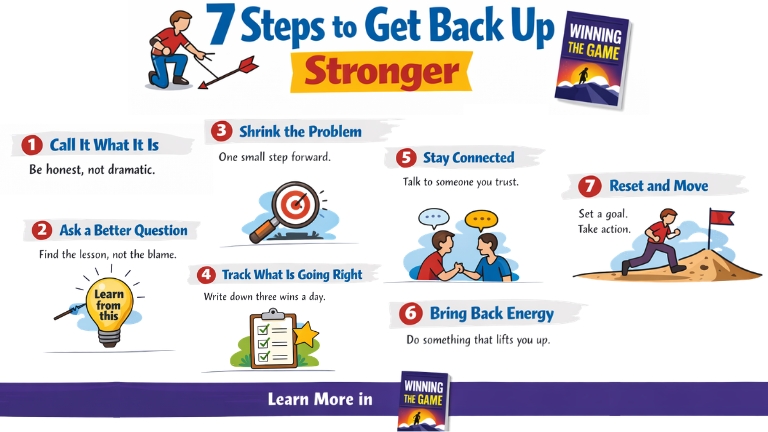
Step One: Call It What It Is
You cannot move forward if you are still pretending nothing is wrong. If something has gone off track, say it. Not dramatically. Not with a long speech. Just honestly.
“This didn’t work.”
That’s it.
This sounds simple, but it’s often skipped. People either deny the problem or overreact to it. Neither helps. You don’t need a meltdown, and you don’t need denial. You need clarity.
Once you name the problem, you can start dealing with it.
Step Two: Ask a Better Question
After a setback, most people ask, “Why does this always happen to me?” That question is useless. Try this instead:
“What can I learn from this?”
It shifts your focus from blame to progress.
A client once told me about a business idea that failed after six months. He lost money and confidence. His first reaction was to scrap everything and start something completely different. We paused and asked one question: “What actually worked?”
It turned out that his marketing was strong, his customer engagement was high, and people liked the service. The issue was pricing and structure.
Instead of starting again, he adjusted the model. Within three months, the business was profitable.
Same person. Same idea. Different response.
Step Three: Shrink the Problem
When something goes wrong, it often feels bigger than it is. Your mind jumps ahead and builds a list of everything that might go wrong next.
You don’t need that list.
You need one step.
Ask yourself:
“What is the smallest action I can take right now?”
Not tomorrow. Not next week. Right now.
If your workload feels overwhelming, don’t plan your whole week. Open one document. Send one email. Make one call.
Progress builds momentum. Momentum builds confidence. You don’t need a perfect plan. You need movement.
Step Four: Track What Is Going Right
When things go wrong, your brain focuses on what is missing. It ignores what is working.
That’s a problem.
Start keeping a simple “win log.” Each day, write down three things that went well. They don’t need to be impressive.
- You showed up
- You finished a task
- You had a good conversation
This is not about pretending everything is perfect. It’s about seeing the full picture.
People who recover quickly from setbacks don’t ignore problems. They balance them with progress.
Step Five: Stay Connected
Setbacks feel heavier when you carry them alone.
You don’t need a large network. You need one or two people you can speak to honestly.
Say what’s going on. Say what you’re struggling with. You might get advice. You might just get perspective. Both help.
I’ve seen people stay stuck for weeks because they kept everything to themselves. Then they have one conversation, and suddenly the situation looks manageable again.
You are not meant to figure everything out on your own.
Step Six: Bring Back Energy
When something goes wrong, people often remove anything that feels like “fun.” They double down on work and strip out anything that lifts their mood. That usually makes things worse.
Energy matters.
If you feel drained, your thinking suffers. Your decisions slow down. Your confidence drops.
So ask yourself: “What gives me energy that I can do today?”
It might be a walk. Music. A short break. Time with someone you enjoy being around. This is not about avoiding work. It’s about keeping yourself in a state where you can handle it.
When you feel better, you perform better. It’s not complicated.
Step Seven: Reset and Move
At some point, you need to stop analysing and start again. Not from scratch. From where you are now.
Set a small target for the next 24 hours. Something clear and achievable. Then do it. Not perfectly. Just consistently.
This is where many people hesitate. They wait until they feel ready. They want clarity, confidence, and certainty before they act.
You don’t get those first. You build them through action.
A Different Way to See Setbacks
What if setbacks were not interruptions, but part of the process?
Think about any skill you’ve learned. Driving. Running a business. Raising a family. None of it went smoothly from start to finish. You made mistakes. You adjusted. You improved. That’s the pattern.
The people who move forward are not the ones who avoid problems. They are the ones who respond quickly when things go wrong.
They don’t sit in frustration for long. They shift, act, and keep going.
A Quick Check-In
Right now, what is your current “storm”?
Be honest. What has gone off track?
Now ask yourself:
- What is one thing I can learn from this?
- What is one small step I can take today?
- Who can I speak to about it?
If you answer those three questions and act on them, you are already moving forward.
Why This Matters
Resilience is not about being tough all the time. It’s about being responsive. It’s about noticing when things slip, adjusting quickly, and keeping yourself moving.
In Winning The Game, this idea runs through everything. Progress is not about getting everything right. It’s about staying in the game long enough to improve.
You don’t need perfect conditions. You need a way to respond when conditions change.
That’s what keeps you moving.
You’ve handled difficult moments before. You’re still here. That’s evidence.
The question is not whether you will face setbacks again. You will.
The real question is this:
Next time something knocks you off course, will you stop… or will you reset and take the next step?
That choice changes everything.